

Running a promotion across Europe can feel like a simple extension of a UK mechanic. Add a couple of markets, translate the Terms and Conditions, and you are ready to go.
In reality, European promotions reward teams that plan early and design for differences. As Sam Winterbourne, IPM Regulatory Affairs Advisor, framed it in the session, Europe is not a single market. It is a set of jurisdictions with distinct expectations around chance, skill, filings, timelines, prize handling, and data.
This webinar brought together practical expertise from Zoe Lyons, IPM European Advisor and Gemma Roberts of Cloud Nine Incentives, with a clear objective: help brands and agencies spot the common pressure points early, so European promotions feel predictable, costed properly, and far easier to deliver with confidence.


How to get comfortable running promotions in Europe Recap
Start with the markets, then build the mechanic
The strongest theme throughout the session was sequencing. The safest approach is to confirm where you are running, then shape the mechanic around what those markets allow and expect.
That matters because “game of chance” and “game of skill” can be treated very differently depending on the jurisdiction. Some markets push teams towards genuine skill-based entry, while others allow chance mechanics but introduce administrative steps that change your timeline.
The practical takeaway: if you start by forcing the same mechanic everywhere, you risk retrofitting compliance later. That is when budgets, timelines, and comms get squeezed.
Be precise on chance versus skill, because design details change compliance
Zoe highlighted how small creative choices can shift the regulatory profile of a campaign. If a market expects a true game of skill, the details matter, including how questions work, how ties are resolved, and how judging is organised.
This has real operational impact. Judging criteria, local language considerations, and winner contact windows all need to be defined upfront, particularly when entry volumes are hard to predict.
A useful mindset from the webinar: treat “skill” as a format you must be able to defend, not just a label you apply.

Start with the markets, then build the mechanic
The strongest theme throughout the session was sequencing. The safest approach is to confirm where you are running, then shape the mechanic around what those markets allow and expect.
That matters because “game of chance” and “game of skill” can be treated very differently depending on the jurisdiction. Some markets push teams towards genuine skill-based entry, while others allow chance mechanics but introduce administrative steps that change your timeline.
The practical takeaway: if you start by forcing the same mechanic everywhere, you risk retrofitting compliance later. That is when budgets, timelines, and comms get squeezed.
Be precise on chance versus skill, because design details change compliance
Zoe highlighted how small creative choices can shift the regulatory profile of a campaign. If a market expects a true game of skill, the details matter, including how questions work, how ties are resolved, and how judging is organised.
This has real operational impact. Judging criteria, local language considerations, and winner contact windows all need to be defined upfront, particularly when entry volumes are hard to predict.
A useful mindset from the webinar: treat “skill” as a format you must be able to defend, not just a label you apply.
Timelines are not uniform, and filings can be the hidden blocker
A recurring theme was lead time. Some jurisdictions require pre-launch filings, permits, or documentation that is easy to underestimate if you are used to UK norms.
The session explored examples where documentation and process expectations can bring in fixed deadlines ahead of launch, and where winner selection requirements and local oversight can remove flexibility later in the campaign.
The practical takeaway: build a timeline that is market-led, not campaign-led. If you want one European launch date, you need to work backwards from the slowest moving jurisdiction.



Translation is not a final polish step, it is a commitment
Translation came up as a real risk point, not just a production detail. Once Terms and Conditions are submitted for translation, changing clauses later can mean rework, delays, and cost.
In practice, that means teams benefit from locking core mechanics, key terms, and local compliance requirements before translation begins. It also means aligning internal stakeholders early, because “one more tweak” after translation starts can have a disproportionate impact.
Tax and prize obligations can change the true cost of a campaign
The webinar also covered how tax can affect promotions, particularly where games of chance attract different tax treatments to games of skill.
This is where early scoping pays off. If tax is triggered, who pays it can vary. That single question can affect your prize pool budget, finance approvals, and how you communicate prize receipt and any conditions to winners.
The practical takeaway: treat tax as a scoping question at the start, not a finance check at the end.
Timelines are not uniform, and filings can be the hidden blocker
A recurring theme was lead time. Some jurisdictions require pre-launch filings, permits, or documentation that is easy to underestimate if you are used to UK norms.
The session explored examples where documentation and process expectations can bring in fixed deadlines ahead of launch, and where winner selection requirements and local oversight can remove flexibility later in the campaign.
The practical takeaway: build a timeline that is market-led, not campaign-led. If you want one European launch date, you need to work backwards from the slowest moving jurisdiction.
Translation is not a final polish step, it is a commitment
Translation came up as a real risk point, not just a production detail. Once Terms and Conditions are submitted for translation, changing clauses later can mean rework, delays, and cost.
In practice, that means teams benefit from locking core mechanics, key terms, and local compliance requirements before translation begins. It also means aligning internal stakeholders early, because “one more tweak” after translation starts can have a disproportionate impact.
Tax and prize obligations can change the true cost of a campaign
The webinar also covered how tax can affect promotions, particularly where games of chance attract different tax treatments to games of skill.
This is where early scoping pays off. If tax is triggered, who pays it can vary. That single question can affect your prize pool budget, finance approvals, and how you communicate prize receipt and any conditions to winners.
The practical takeaway: treat tax as a scoping question at the start, not a finance check at the end.
Fulfilment is part of compliance, and prize design needs local common sense
Gemma brought the delivery lens to life with a simple but powerful point: even when a prize concept looks universal, what feels desirable and workable can vary market by market.
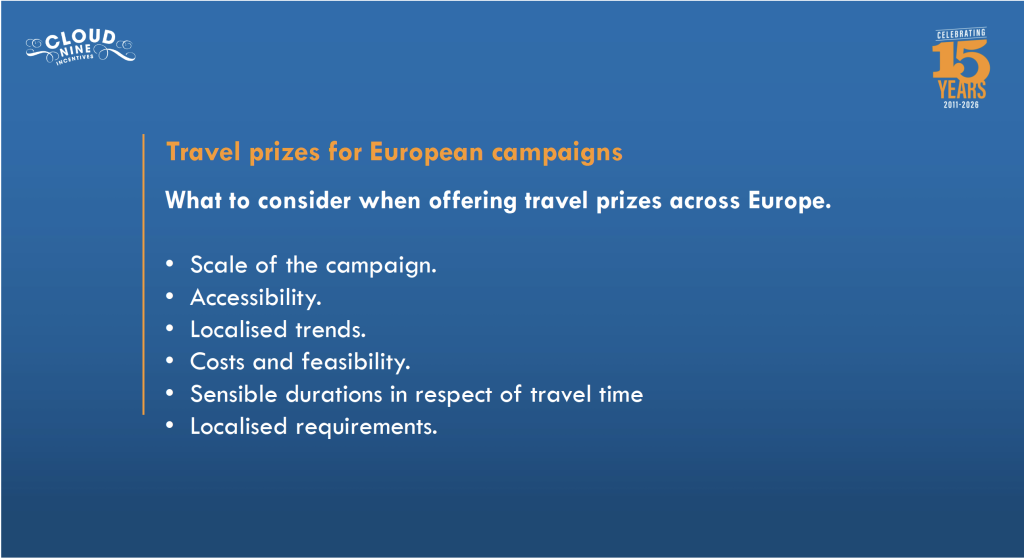
Travel and experience prizes were a strong example. Factors like journey time, practical durations, local preferences, insurance expectations, and what is considered a complete prize in a given market all influence suitability.
The operational takeaway: the best European prize pools are designed for local reality, not just headline appeal.
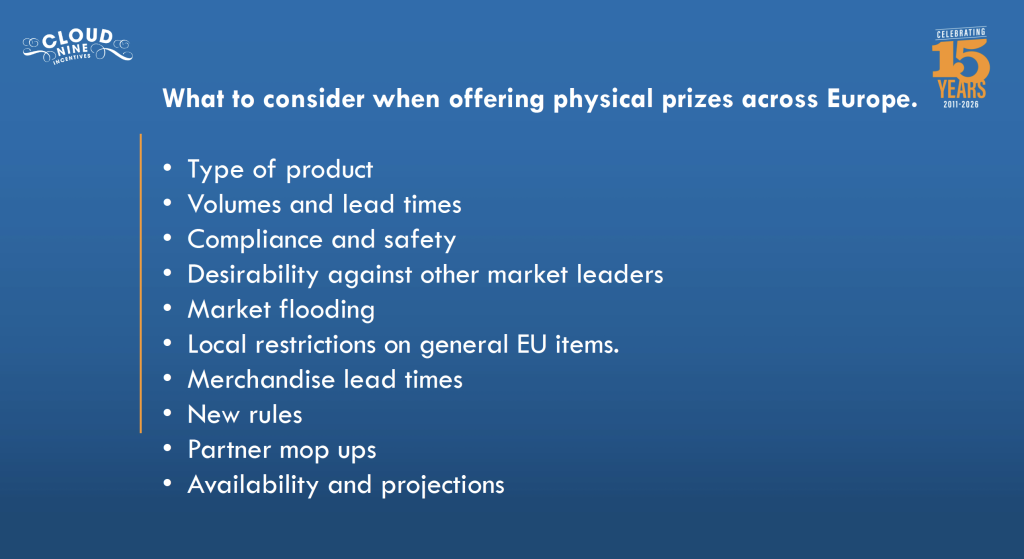
Practical checklist: what to confirm before you say yes to Europe
“Some markets will require individual prize inclusion, such as spending money, travel insurance, additional nights due to flight connections, and travel time.”

Fulfilment is part of compliance, and prize design needs local common sense
Gemma brought the delivery lens to life with a simple but powerful point: even when a prize concept looks universal, what feels desirable and workable can vary market by market.
Travel and experience prizes were a strong example. Factors like journey time, practical durations, local preferences, insurance expectations, and what is considered a complete prize in a given market all influence suitability.
The operational takeaway: the best European prize pools are designed for local reality, not just headline appeal.
Geography matters too. London remains “the core destination for experiential”, she says, spanning everything from major railway station frontage to the South Bank and Covent Garden. “Activating in London is a sign of confidence and of intent,” she adds. Manchester is the “very clear second city”, and she notes it has now crept past Birmingham for the first time, helped by strong student numbers and a reputation as a place brand can trial formats before rolling them out nationwide. Birmingham, Leeds and Liverpool form the next tier, and venue-wise, shopping centres and travel hubs are “evenly split at the top”, with universities also a consistent part of the mix.
One of Nancy’s clearest signals for 2026 sits in tech and streaming, where brands are using live space to make the intangible tangible. She lists names including Samsung, Netflix, Audible, Virgin, Spotify, Adobe, Google and Disney+, and argues that “giving consumers a hands-on experience seems to be the route moving forward for tech brands”. Samsung is her headline example, “a huge campaign with 84 bookings”, spanning 57 venues in 27 cities and 297 live activations. The same instinct is driving newer names into the real world too, with OpenAI launching ChatGPT’s first large-scale brand campaign, signalling that tech brands are increasingly building familiarity through physical presence. For Nancy, it all reinforces the wider shift: “experiential is being planned less as a one-off and more as a scalable, repeatable system”.
“Some markets will require individual prize inclusion, such as spending money, travel insurance, additional nights due to flight connections, and travel time.”
So what did the webinar tell us?
Across the session, the message was clear: getting comfortable running promotions in Europe comes down to planning for difference, not hoping for uniformity. Sam set the scene by reframing Europe as a collection of jurisdictions with distinct expectations, while Zoe brought the practical reality to life, from the chance-versus-skill question and the impact of filings and lead times to the hidden cost drivers like tax and translation.
Gemma’s fulfilment lens reinforced that prize design is only as strong as its local suitability, and that details such as travel time, insurance, spending money, and market-specific inclusions can shape both compliance and consumer experience.
The result is a simple takeaway for teams scoping multi-market activity: start with where you are running, build a realistic timeline around the slowest market, lock your Terms and Conditions early, and treat fulfilment as a core part of the promotional plan, not an afterthought.
Watch the full webinar on demand
IPM members can access and watch the full webinar on demand via the IPM Members Area.
If you are planning an upcoming promotion, whether it is UK only or running internationally, the IPM Legal Advisory Service can help you get it right from the start. Available to both members and non-members, our team can sense check mechanics, strengthen Terms and Conditions, and flag the key compliance risks before you launch. Get in touch with the IPM to discuss how we can support your next campaign.
So what did the webinar tell us?
Across the session, the message was clear: getting comfortable running promotions in Europe comes down to planning for difference, not hoping for uniformity. Sam set the scene by reframing Europe as a collection of jurisdictions with distinct expectations, while Zoe brought the practical reality to life, from the chance-versus-skill question and the impact of filings and lead times to the hidden cost drivers like tax and translation.
Gemma’s fulfilment lens reinforced that prize design is only as strong as its local suitability, and that details such as travel time, insurance, spending money, and market-specific inclusions can shape both compliance and consumer experience.
The result is a simple takeaway for teams scoping multi-market activity: start with where you are running, build a realistic timeline around the slowest market, lock your Terms and Conditions early, and treat fulfilment as a core part of the promotional plan, not an afterthought.
Watch the full webinar on demand
IPM members can access and watch the full webinar on demand via the IPM Members Area.
If you are planning an upcoming promotion, whether it is UK only or running internationally, the IPM Legal Advisory Service can help you get it right from the start. Available to both members and non members, our team can sense check mechanics, strengthen Terms and Conditions, and flag the key compliance risks before you launch. Get in touch with the IPM to discuss how we can support your next campaign.
News
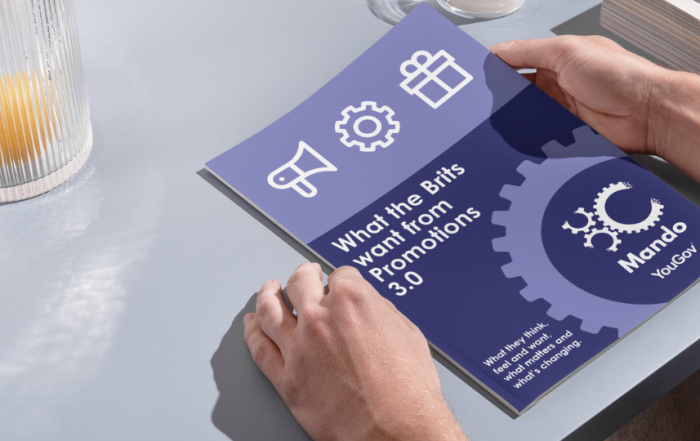
What the Mando White Paper Told Us About Promotions in 2026
A quick IPM recap of What Brits Want from Promotions 3.0, covering key consumer behaviours, motivations and insights shaping effective promotions in 2026.

How to get comfortable running promotions in Europe Recap
A quick IPM recap on running promotions in Europe, covering the key watch outs around mechanics, timelines, filings, translation, tax, and fulfilment.
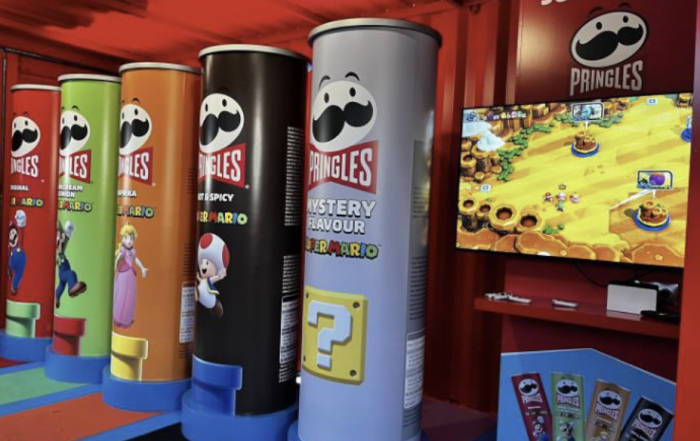
Pringles × Super Mario: The Boss Level Brand Partnership That Won the IPM Grand Prix
Brand Culture, last year’s IPM Grand Prix winners, reveal how Pringles × Super Mario turned a brand partnership into shelf-side excitement, from the Mystery Flavour “question block” idea to collectable character cans.
News
What the Mando White Paper Told Us About Promotions in 2026
A quick IPM recap of What Brits Want from Promotions 3.0, covering key consumer behaviours, motivations and insights shaping effective promotions in 2026.
How to get comfortable running promotions in Europe Recap
A quick IPM recap on running promotions in Europe, covering the key watch outs around mechanics, timelines, filings, translation, tax, and fulfilment.
Pringles × Super Mario: The Boss Level Brand Partnership That Won the IPM Grand Prix
Brand Culture, last year’s IPM Grand Prix winners, reveal how Pringles × Super Mario turned a brand partnership into shelf-side excitement, from the Mystery Flavour “question block” idea to collectable character cans.