

As AI continues to reshape the marketing landscape, agencies are facing a new challenge: not simply adopting AI, but proving its value to increasingly demanding clients.
That was the key message from a recent IPM webinar featuring Chris Kemp, Founder of Ingenuity Group, who shared findings from Ingenuity+ latest research among 250 senior UK marketing leaders. The session explored how brand expectations are evolving, where agencies are meeting those expectations, and where significant gaps remain.
While AI dominated much of the conversation, the webinar also revealed wider shifts in accountability, agency selection and the future of client-agency relationships.

Agency Growth in the Age of AI: Closing the Expectations Gap
Agency Growth in the Age of AI: Closing the Expectations Gap
As AI continues to reshape the marketing landscape, agencies are facing a new challenge: not simply adopting AI, but proving its value to increasingly demanding clients.
That was the key message from a recent IPM webinar featuring Chris Kemp, Founder of Ingenuity Group, who shared findings from Ingenuity+ latest research among 250 senior UK marketing leaders. The session explored how brand expectations are evolving, where agencies are meeting those expectations, and where significant gaps remain.
While AI dominated much of the conversation, the webinar also revealed wider shifts in accountability, agency selection and the future of client-agency relationships.
Marketing leaders are under more pressure than ever
The research paints a picture of a marketing community operating under increasing scrutiny.
According to Ingenuity’s findings, 70% of senior marketers say accountability is harder today than it was two years ago. Growing pressure from boards, investors and private equity ownership structures means marketers are expected to deliver measurable growth while navigating a rapidly changing media and technology environment.
For agencies, this matters because clients are increasingly looking for partners who can help them demonstrate impact, not simply deliver outputs.
As Kemp noted during the webinar, trusted relationships remain critical. While technology is changing the way marketing is delivered, marketers still need partners who can provide confidence, guidance and commercial understanding.
AI has moved from innovation to expectation
Perhaps the clearest finding from the research is that AI is no longer viewed as a differentiator.
Instead, it is becoming a baseline expectation.
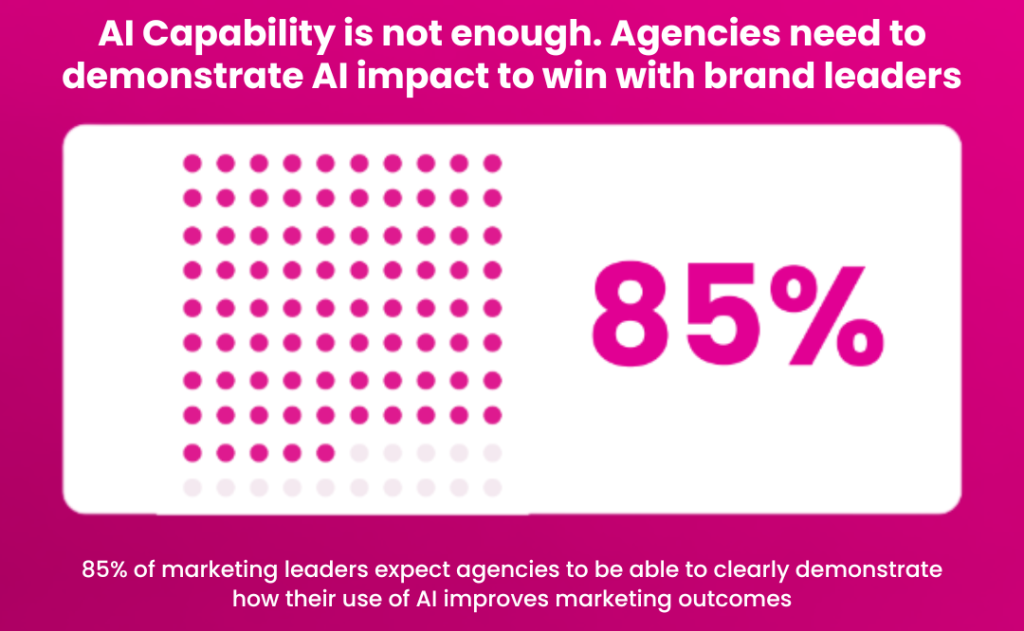
The study found that 86% of marketing leaders are more likely to select an agency that can clearly demonstrate effective use of AI. In other words, AI capability is rapidly becoming part of the agency selection criteria rather than a value-added extra.
The expectation extends across a wide range of applications, including:
- Predictive campaign analysis
- Automated reporting and insight generation
- Creative development support
- Faster testing and optimisation
- Enhanced audience understanding
- Operational efficiency improvements
For agencies, the message is clear: clients increasingly expect AI-enabled delivery as standard.
Demonstrating impact matters more than talking about capability
While AI adoption is rising, the research revealed a significant credibility gap.
Although marketers expect agencies to be proficient in AI, many are not yet convinced their current partners are delivering meaningful results.
Just 46% of respondents strongly agreed that their agency is using AI effectively. Confidence falls further when marketers are asked whether agencies are applying AI in ways that genuinely improve marketing performance.
The implication is that simply talking about AI is no longer enough, clients want evidence. They want to understand how AI is improving effectiveness, speeding up delivery, generating stronger insights or creating measurable business outcomes.
As Kemp highlighted, agencies need to move beyond discussing tools and instead demonstrate tangible impact on performance.
AI should create value, not just efficiency
One of the more interesting themes from the discussion was the role AI can play in creating value rather than simply reducing costs.
While automation and efficiency remain important benefits, marketers are increasingly interested in how AI can enhance creativity, accelerate experimentation and support better decision-making.
The research identified growing interest in areas such as:
- Rapid testing and learning
- Creative development and ideation
- Insight generation
- Campaign optimisation
- Strategic planning support
This reflects a broader shift in how organisations are thinking about AI. Rather than replacing human expertise, the most successful applications appear to be those that augment existing capabilities and enable teams to work smarter.
For agencies, that presents an opportunity to reposition AI as a growth enabler rather than a cost-saving tool.
Investment is continuing to rise
The findings suggest that marketing leaders are backing their AI ambitions with budget.
On average, respondents reported allocating around 15% of marketing budgets towards AI-related activity, with more mature organisations investing considerably more.
At the same time, broader marketing spend remains heavily focused on digital channels, with search and social continuing to attract significant investment.
This combination of increased AI investment and continued digital growth suggests that agencies capable of combining technology, data and creativity are likely to be well positioned in the years ahead.
The pitch process is changing too
Beyond AI, the webinar also explored changing attitudes towards agency selection.
Traditionally, agency pitches have been associated with lengthy procurement processes involving multiple stages and significant resource commitments.
However, the research suggests marketers are increasingly favouring faster, more agile approaches.
Many respondents now view agency selection as a process driven by recommendations, chemistry meetings and targeted conversations rather than extensive six-month pitch programmes.
Interestingly, there appears to be a disconnect between how brands and agencies perceive the process. While marketers are embracing speed and flexibility, many agencies still associate pitching with large-scale, formal reviews.
For agencies looking to win new business, this highlights the importance of responsiveness, relationship building and demonstrating value quickly.
The opportunity for agencies
The webinar concluded with an optimistic message: while client expectations are undoubtedly rising, the findings point towards significant opportunities for agencies willing to evolve.
Marketing leaders are increasing investment, actively reviewing agency relationships and looking for partners who can help them navigate a complex landscape shaped by AI, data and growing commercial pressure.
The challenge is no longer whether agencies should adopt AI, the challenge is proving how it helps clients achieve better outcomes.
Those that can combine technological capability with strategic thinking, creativity and measurable impact will be best placed to strengthen relationships and unlock future growth.
As AI becomes standard practice across the industry, the agencies that stand out will be those that make the benefits tangible, relevant and commercially meaningful for their clients.
Marketing leaders are under more pressure than ever
The research paints a picture of a marketing community operating under increasing scrutiny.
According to Ingenuity’s findings, 70% of senior marketers say accountability is harder today than it was two years ago. Growing pressure from boards, investors and private equity ownership structures means marketers are expected to deliver measurable growth while navigating a rapidly changing media and technology environment.
For agencies, this matters because clients are increasingly looking for partners who can help them demonstrate impact, not simply deliver outputs.
As Kemp noted during the webinar, trusted relationships remain critical. While technology is changing the way marketing is delivered, marketers still need partners who can provide confidence, guidance and commercial understanding.
AI has moved from innovation to expectation
Perhaps the clearest finding from the research is that AI is no longer viewed as a differentiator.
Instead, it is becoming a baseline expectation.
The study found that 86% of marketing leaders are more likely to select an agency that can clearly demonstrate effective use of AI. In other words, AI capability is rapidly becoming part of the agency selection criteria rather than a value-added extra.
The expectation extends across a wide range of applications, including:
- Predictive campaign analysis
- Automated reporting and insight generation
- Creative development support
- Faster testing and optimisation
- Enhanced audience understanding
- Operational efficiency improvements
For agencies, the message is clear: clients increasingly expect AI-enabled delivery as standard.
Demonstrating impact matters more than talking about capability
While AI adoption is rising, the research revealed a significant credibility gap.
Although marketers expect agencies to be proficient in AI, many are not yet convinced their current partners are delivering meaningful results.
Just 46% of respondents strongly agreed that their agency is using AI effectively. Confidence falls further when marketers are asked whether agencies are applying AI in ways that genuinely improve marketing performance.
The implication is that simply talking about AI is no longer enough, clients want evidence. They want to understand how AI is improving effectiveness, speeding up delivery, generating stronger insights or creating measurable business outcomes.
As Kemp highlighted, agencies need to move beyond discussing tools and instead demonstrate tangible impact on performance.
AI should create value, not just efficiency
One of the more interesting themes from the discussion was the role AI can play in creating value rather than simply reducing costs.
While automation and efficiency remain important benefits, marketers are increasingly interested in how AI can enhance creativity, accelerate experimentation and support better decision-making.
The research identified growing interest in areas such as:
- Rapid testing and learning
- Creative development and ideation
- Insight generation
- Campaign optimisation
- Strategic planning support
This reflects a broader shift in how organisations are thinking about AI. Rather than replacing human expertise, the most successful applications appear to be those that augment existing capabilities and enable teams to work smarter.
For agencies, that presents an opportunity to reposition AI as a growth enabler rather than a cost-saving tool.
The pitch process is changing too
Beyond AI, the webinar also explored changing attitudes towards agency selection.
Traditionally, agency pitches have been associated with lengthy procurement processes involving multiple stages and significant resource commitments.
However, the research suggests marketers are increasingly favouring faster, more agile approaches.
Many respondents now view agency selection as a process driven by recommendations, chemistry meetings and targeted conversations rather than extensive six-month pitch programmes.
Interestingly, there appears to be a disconnect between how brands and agencies perceive the process. While marketers are embracing speed and flexibility, many agencies still associate pitching with large-scale, formal reviews.
For agencies looking to win new business, this highlights the importance of responsiveness, relationship building and demonstrating value quickly.
The opportunity for agencies
The webinar concluded with an optimistic message: while client expectations are undoubtedly rising, the findings point towards significant opportunities for agencies willing to evolve.
Marketing leaders are increasing investment, actively reviewing agency relationships and looking for partners who can help them navigate a complex landscape shaped by AI, data and growing commercial pressure.
The challenge is no longer whether agencies should adopt AI, the challenge is proving how it helps clients achieve better outcomes.
Those that can combine technological capability with strategic thinking, creativity and measurable impact will be best placed to strengthen relationships and unlock future growth.
As AI becomes standard practice across the industry, the agencies that stand out will be those that make the benefits tangible, relevant and commercially meaningful for their clients.
Investment is continuing to rise
The findings suggest that marketing leaders are backing their AI ambitions with budget.
On average, respondents reported allocating around 15% of marketing budgets towards AI-related activity, with more mature organisations investing considerably more.
At the same time, broader marketing spend remains heavily focused on digital channels, with search and social continuing to attract significant investment.
This combination of increased AI investment and continued digital growth suggests that agencies capable of combining technology, data and creativity are likely to be well positioned in the years ahead.
News
What Ingenuity’s latest research tells us about client expectations in the age of AI
A quick IPM recap of What Brits Want from Promotions 3.0, covering key consumer behaviours, motivations and insights shaping effective promotions in 2026.
Mando Presents: Understanding Loyalty in Europe 4.0
A quick IPM recap of What Brits Want from Promotions 3.0, covering key consumer behaviours, motivations and insights shaping effective promotions in 2026.

Excited, Anxious, Oblivious: What N2O’s Generation Series Reveals About AI
A quick IPM recap of What Brits Want from Promotions 3.0, covering key consumer behaviours, motivations and insights shaping effective promotions in 2026.
News
What Ingenuity’s latest research tells us about client expectations in the age of AI
A quick IPM recap of What Brits Want from Promotions 3.0, covering key consumer behaviours, motivations and insights shaping effective promotions in 2026.
Mando Presents: Understanding Loyalty in Europe 4.0
A quick IPM recap of What Brits Want from Promotions 3.0, covering key consumer behaviours, motivations and insights shaping effective promotions in 2026.
Excited, Anxious, Oblivious: What N2O’s Generation Series Reveals About AI
A quick IPM recap of What Brits Want from Promotions 3.0, covering key consumer behaviours, motivations and insights shaping effective promotions in 2026.