

AI might dominate headlines, but according to N2O’s latest Generation Series webinar, consumer attitudes towards it are far more nuanced than many brands assume.
The session, titled Excited, Anxious, Oblivious, was presented by Emily Harris, Head of Marketing at N2O and author of the Generation Series Vol 8 report. It explored how different generations are engaging with AI today, from ChatGPT adoption and AI-assisted shopping to consumer trust, creative content and the future of AI agents.

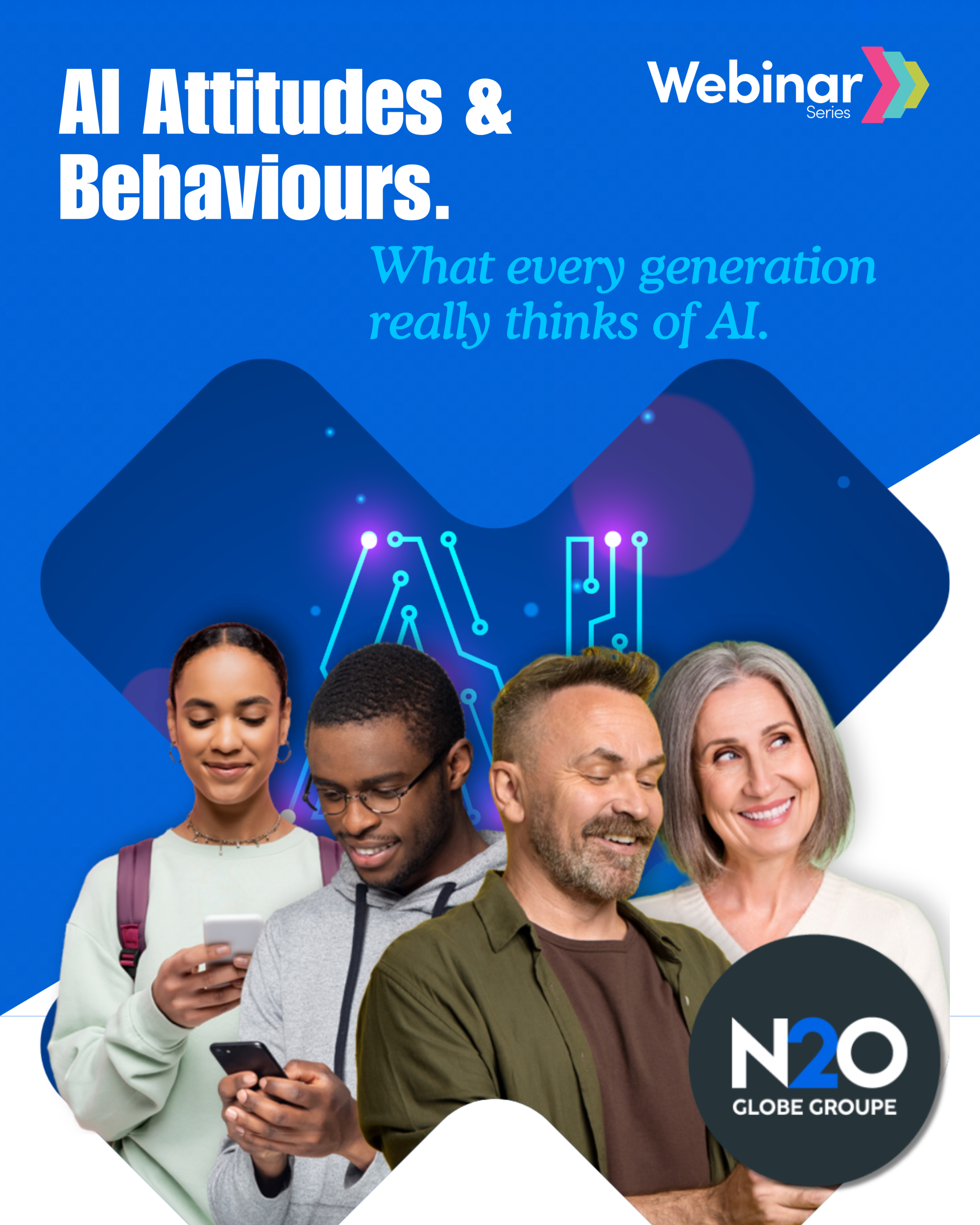
Excited, Anxious, Oblivious: What N2O’s Generation Series Reveals About AI
The key takeaway? AI is already mainstream for some audiences, but completely irrelevant for others. And that gap matters.
One of the strongest themes throughout the webinar was just how steep the adoption divide currently is.
Among Gen Z, AI is already embedded into everyday behaviour. 62% said they had used ChatGPT in the last month, while nearly half interact with chatbots weekly or daily. For this generation, AI is becoming infrastructure rather than experimentation.
Millennials are close behind, with workplace tools acting as the biggest gateway into adoption.
But the story changes sharply with older generations.
Nearly half of Gen X respondents said they haven’t used any AI tool, while Baby Boomers remain largely disconnected from the category. N2O argued this isn’t necessarily resistance; instead, AI simply hasn’t yet proven enough relevance or value to earn their attention.
Excitement and anxiety now coexist – across every generation
The webinar also challenged the idea that younger generations are universally optimistic about AI.
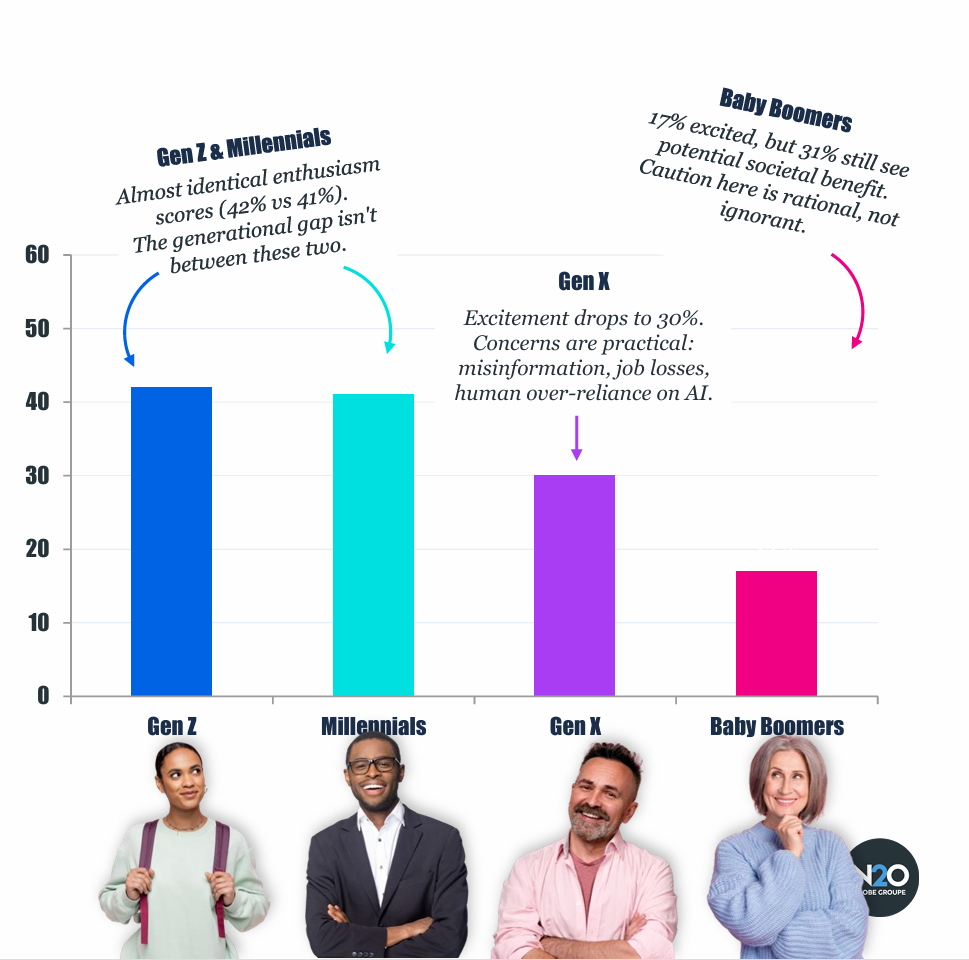
While Gen Z showed the highest levels of excitement overall, they also expressed significant concern. 68% said AI concerns them as much as climate change, despite believing it could deliver societal benefits.
Across all generations, enthusiasm consistently dropped with age, but concern remained high everywhere.
Harris highlighted a confidence gap that should worry brands: although 39% of Gen Z consumers said they feel confident identifying AI-generated content, only 3% of Baby Boomers said the same.
That creates an important brand challenge: consumers increasingly believe AI content is everywhere, but many don’t feel equipped to recognise it.
AI is already influencing purchasing behaviour
Another major discussion point focused on how AI is beginning to shape the purchase journey.
Millennials currently lead the shift, with one in four already using AI chatbots to research products before buying. Whereas for Gen Z, social media still dominates product discovery, but chatbot usage is growing rapidly alongside it. Meanwhile, Gen X and Baby Boomers continue to rely primarily on traditional search engines and retailer websites, at least for now.
N2O described this as a strategic growth point for brands. Search visibility has long been critical for discoverability and now AI visibility may matter just as much.
However, consumers are selective about where they welcome AI recommendations. The webinar highlighted strong openness towards AI support in categories like travel, technology and restaurants, where choice overload and product comparison create obvious value. But resistance rises sharply in areas requiring trust, personal identity or human judgement, including fashion, financial services and healthcare
Consumers remain wary of AI-generated advertising
The session also explored attitudes towards AI-generated creative and advertising.
Consumers appear relatively comfortable with AI in entertainment settings such as gaming, music and comedy, where experimentation feels expected and low risk, but tolerance drops significantly when AI content attempts to appear authentic.
Advertising proved especially challenging.
Across every generation, between 35% and 55% of respondents described themselves as “very uninterested” in advertising they knew to be AI-generated. The strongest resistance appeared in high-trust sectors, including healthcare, legal services, politics and news, areas where consumers see human oversight and transparent labelling as non-negotiable.
“Entertainment is the open door. Advertising is the wall.”
AI agents may be coming – but trust still lags behind
While AI agents are receiving huge attention across the industry, consumer readiness remains limited.
Only 24% of Gen Z respondents had used an AI agent of any kind, dropping to just 8% among Baby Boomers.
Information gathering, research and summarisation attracted the highest levels of trust. Administrative support, like scheduling and reminders, showed growing acceptance too. Willingness dropped dramatically around purchases, money management and autonomous decision-making.
Just 4% of consumers overall said they would feel comfortable allowing AI to make purchases on their behalf.N2O’s advice to brands was cautious but practical: start by using AI for smaller, lower-risk tasks, make sure it works well, and build consumer trust before using it for bigger or more important decisions.
Three principles brands should apply now:
Ultimately, the webinar argued that AI adoption is no longer simply a technology conversation. And the brands that succeed won’t necessarily be the fastest adopters; they’ll be the ones that understand where consumers are comfortable, where they remain cautious, and how to bridge that gap responsibly.
The full Generation Series Vol 8 report — AI Attitudes & Behaviours — along with the rest of N2O’s Generation Series, is available to download here.
The key takeaway? AI is already mainstream for some audiences, but completely irrelevant for others. And that gap matters.
One of the strongest themes throughout the webinar was just how steep the adoption divide currently is.
Among Gen Z, AI is already embedded into everyday behaviour. 62% said they had used ChatGPT in the last month, while nearly half interact with chatbots weekly or daily. For this generation, AI is becoming infrastructure rather than experimentation.
Millennials are close behind, with workplace tools acting as the biggest gateway into adoption.
But the story changes sharply with older generations.
Nearly half of Gen X respondents said they haven’t used any AI tool, while Baby Boomers remain largely disconnected from the category. N2O argued this isn’t necessarily resistance; instead, AI simply hasn’t yet proven enough relevance or value to earn their attention.
Excitement and anxiety now coexist – across every generation
The webinar also challenged the idea that younger generations are universally optimistic about AI.
While Gen Z showed the highest levels of excitement overall, they also expressed significant concern. 68% said AI concerns them as much as climate change, despite believing it could deliver societal benefits.
Across all generations, enthusiasm consistently dropped with age, but concern remained high everywhere.
Harris highlighted a confidence gap that should worry brands: although 39% of Gen Z consumers said they feel confident identifying AI-generated content, only 3% of Baby Boomers said the same.
That creates an important brand challenge: consumers increasingly believe AI content is everywhere, but many don’t feel equipped to recognise it.
AI is already influencing purchasing behaviour
Another major discussion point focused on how AI is beginning to shape the purchase journey.
Millennials currently lead the shift, with one in four already using AI chatbots to research products before buying. Whereas for Gen Z, social media still dominates product discovery, but chatbot usage is growing rapidly alongside it. Meanwhile, Gen X and Baby Boomers continue to rely primarily on traditional search engines and retailer websites, at least for now.
N2O described this as a strategic growth point for brands. Search visibility has long been critical for discoverability and now AI visibility may matter just as much.
However, consumers are selective about where they welcome AI recommendations. The webinar highlighted strong openness towards AI support in categories like travel, technology and restaurants, where choice overload and product comparison create obvious value. But resistance rises sharply in areas requiring trust, personal identity or human judgement, including fashion, financial services and healthcare
Consumers remain wary of AI-generated advertising
The session also explored attitudes towards AI-generated creative and advertising.
Consumers appear relatively comfortable with AI in entertainment settings such as gaming, music and comedy, where experimentation feels expected and low risk, but tolerance drops significantly when AI content attempts to appear authentic.
Advertising proved especially challenging.
Across every generation, between 35% and 55% of respondents described themselves as “very uninterested” in advertising they knew to be AI-generated. The strongest resistance appeared in high-trust sectors, including healthcare, legal services, politics and news, areas where consumers see human oversight and transparent labelling as non-negotiable.
“Entertainment is the open door. Advertising is the wall.”
Three principles brands should apply now:
Ultimately, the webinar argued that AI adoption is no longer simply a technology conversation. And the brands that succeed won’t necessarily be the fastest adopters, they’ll be the ones that understand where consumers are comfortable, where they remain cautious, and how to bridge that gap responsibly.
The full Generation Series Vol 8 report — AI Attitudes & Behaviours — along with the rest of N2O’s Generation Series, is available to download here:
News

IPM Awards 2026 Winners Revealed
Celebrate the stars of promotional marketing at the IPM Awards 2026, where creativity, innovation, and impact take centre stage. Explore all the winners from this year’s IPM Awards.

Experiential Diploma Open Day
A quick IPM recap of What Brits Want from Promotions 3.0, covering key consumer behaviours, motivations and insights shaping effective promotions in 2026.

The IPM Announces New Strategic Partnership with IMA Europe
A quick IPM recap of What Brits Want from Promotions 3.0, covering key consumer behaviours, motivations and insights shaping effective promotions in 2026.
News
IPM Awards 2026 Winners Revealed
Celebrate the stars of promotional marketing at the IPM Awards 2026, where creativity, innovation, and impact take centre stage. Explore all the winners from this year’s IPM Awards.
Experiential Diploma Open Day
A quick IPM recap of What Brits Want from Promotions 3.0, covering key consumer behaviours, motivations and insights shaping effective promotions in 2026.
The IPM Announces New Strategic Partnership with IMA Europe
A quick IPM recap of What Brits Want from Promotions 3.0, covering key consumer behaviours, motivations and insights shaping effective promotions in 2026.